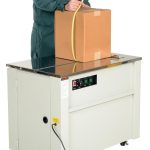

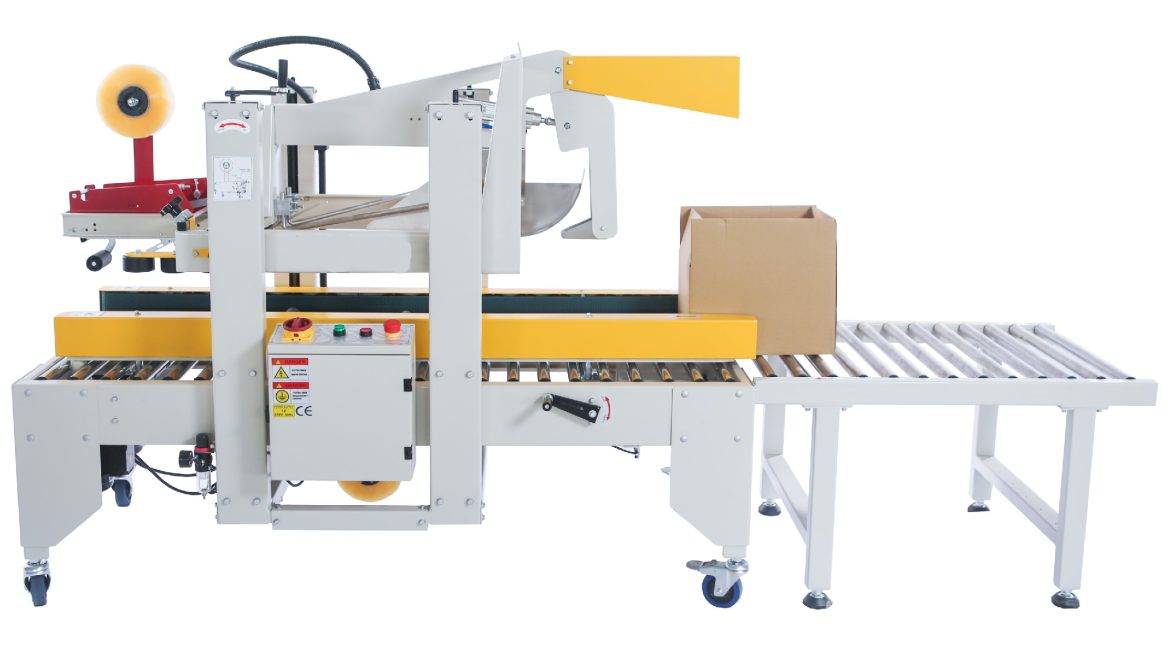
An automatic case sealer is a machine that automatically closes and seals the top and/or bottom flaps of a shipping case (carton) using tape, hot melt adhesive, or glue. It’s a core piece of equipment in packaging lines across industries like food & beverage, e-commerce, pharmaceuticals, and manufacturing.
Here’s a comprehensive breakdown of what you need to know:
How It Works (Basic Process)
- Infeed: An operator or an upstream machine (like a case erector or product loading system) places the filled, open case onto the conveyor of the sealer.
- Flap Folding: As the case moves, guide rails or mechanical “fingers” gently fold the top (and sometimes bottom) flaps closed.
- Sealing: The case passes through the sealing mechanism.
Tape: For tape sealers, tape heads apply pressure-sensitive tape (usually plastic or reinforced) along the center and/or end seams.
Hot Melt: For glue sealers, nozzles apply a bead of hot melt adhesive to the flaps in a specific pattern (e.g., I, U, or 4-6 dots).
- Compression: The sealed case often passes through a compression section where belts or pads hold the flaps firmly until the tape adheres fully or the hot melt adhesive sets.
- Discharge: The sealed, ready-to-ship case exits onto a takeaway conveyor.
Main Types of Automatic Case Sealers
| Type | Description | Best For |
| :— | :— | :— |
| Random Case Sealer | Adjusts automatically to seal cases of different sizes in a random sequence. Uses sensors to measure each case and adjust guide rails and tape heads/glue guns on the fly. | Mixed-size operations like e-commerce fulfillment centers, third-party logistics (3PLs), and distribution centers with high SKU variety. |
| Uniform (Fixed) Case Sealer | Set up manually to seal cases of one specific size. Much faster and more economical for dedicated runs. | High-speed, single-SKU lines (e.g., beverage cans, food products) where the same box runs for hours or days. |
| Top-Only Sealer | Seals only the top flaps. Used when the bottom is pre-sealed (often by a case erector) or when the product is loaded from the top. | End-of-line sealing after manual or automatic packing. Common in many production environments. |
| Top & Bottom Sealer | Seals both the top and bottom flaps in one pass. This is the most common type of automatic sealer. | Complete closure for maximum security, especially when the bottom is not pre-sealed. |
| Tape Sealer | Uses pressure-sensitive tape (PP, PVC, reinforced). Clean, dry process. | General purpose, non-refrigerated environments. Most common type. |
| Hot Melt Glue Sealer | Applies a thermoplastic adhesive. Creates a very strong, tamper-evident bond. | Heavy or unstable loads (prevents flap “spring”), cold/wet environments (glue performs better than tape), and high-security applications. |
Key Benefits of Automating Case Sealing
Increased Speed & Throughput: Can seal hundreds to over 1,000 cases per hour, far exceeding manual taping.
Consistent Seal Quality: Eliminates human error (e.g., missed tape, crooked application, weak adhesion), improving reliability and presentation.
Reduced Labor Costs & Fatigue: Frees up workers for higher-value tasks and eliminates the repetitive strain of manual taping.
Material Savings: Precise application minimizes tape or glue waste compared to manual methods.
Improved Safety: Reduces the risk of cutter-related injuries from manual tape guns.
Line Integration: Seamlessly connects with upstream (case erectors, robotic packers) and downstream (labelers, sorters) equipment for a fully automated line.
Considerations for Selection & Purchase
- Case Specifications: Size range (min/max LxWxH), flute type (corrugation), and flap style (regular slotted, full overlap, etc.).
- Throughput Requirements: Cases per minute/hour you need to achieve.
- Product/Load Characteristics: Weight, stability (does it need compression?), and environment (dusty, cold, humid?).
- Sealing Method: Tape vs. Glue (consider seal strength, cost, and maintenance).
- Integration: How will it connect to your existing conveyor system and upstream/downstream equipment? Floor space footprint?
- Changeover Needs: If you have many sizes, a random sealer is essential. If you have few sizes but frequent changeovers, look for models with quick-change features.
- Safety Features: Emergency stop buttons, safety guards, and interlocks.